Every person has their own unique fingerprints, so they have long been used around the world by law enforcement as a means of identification, but their use as a biometric security measure has also been on the rise since the 1990s. Tensor has been at the forefront of this industry since 2003, when we released the world's first subdermal fingerprint reading time and attendance system; an even more recent addition to our technology is Live Finger Detection from Suprema.
A Whorl Through the History of Fingerprinting
But where did the idea of using fingerprints come from, and when?
The Guinness World Records includes the record 'First identification of individuals using fingerprints', which notes that the earliest known description of forensic use of handprints and fingerprints is from a Chinese document from around 220 BC, 'The Volume of Crime Scene Investigation—Burglary'.
There is also evidence that the ancient Babylonians used thumbprints as a type of personal seal, and fingerprints were used as signatures in China around 1300.
However, it wasn't until the mid-1800s that the idea of using biometrics (the measurements of distinctive characteristics present in the human body) was really embraced. In India in 1858, Sir William Herschel used handprints as a method of distinguishing real employees on payday, helping to cut down on non-employees claiming unearned pay.
Meanwhile, in Britain, Scottish scientist Henry Faulds began investigating fingerprints and asked for help from Charles Darwin in 1880. Darwin was ill so he sent the request to his cousin, Sir Francis Galton, who began collecting prints and classifying different traits; this led in 1892 to the publication of Galton's book 'Fingerprints' — the first fingerprint classification system.
Fingerprinting is most known for its use in law enforcement, and at around the same time as Faulds and Galton's work, French criminologist Alphonse Bertillon began using fingerprints as a means of identifying criminals, and Argentinian police officer Juan Vucetich developed his own fingerprinting system.
The use of fingerprinting as an investigative tool continued apace in the early 20th century: Scotland Yard established its Fingerprint Bureau in 1902; a few years later, the FBI compiled a database of fingerprint files; and in the 1980s, the Japanese National Police Agency established the Automated Fingerprint Identification Systems (AFIS). Since 1999, the UK has used IDENT1 as its database of fingerprints from crime scenes and criminals.
Fingerprinting outside of law enforcement has grown to cover a vast range of uses since then, from airport security to smartphone access.
The first commercially available hand geometry system became available in 1974, which was used as the basis for access control and time and attendance, along with personal identification. The increased availability of computers throughout the 1980s-90s facilitated the move to digital fingerprint databases and the increased use of fingerprints as a means of identification. Initially, however, digital storage space was so expensive that only the finer details were kept, not the whole fingerprint.
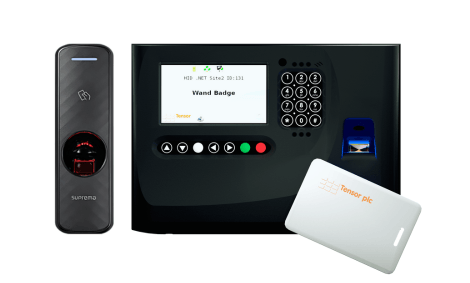
The world's first biometric Time and Attendance verification and Access Control system, the T1582 fingerprint reader, was launched by Tensor in 2003 as an add-on for clocking stations, making the system more infallible to time fraud. A year later Tensor launched a low-cost device for securing laptops using fingerprints.
Apple's Touch ID technology was introduced in 2013, and since then smartphones, tablets and laptops have included built-in capability for using fingerprints for security; fingerprint identification was joined, and has subsequently become somewhat superseded, by other forms of biometrics, such as facial recognition, retinal scans, and voice analysis.
Tensor's latest fingerprint readers include technology to ensure they are fraud-proof, with Live Finger Detection from Suprema enabling the system to block fake fingerprints and determine if a print is part of a live finger. You can read more about Fingerprint Access Control here.
If you're interested in learning more about fingerprints, including what they are, when they form, and more, take a look at our blog Ten Facts About Fingerprints.